From bottle to ad: Golden Hour Serum
One 3D build of a skincare bottle, turned into a launch film, a ready-to-run ad cut and a set of product stills. SOLENNE is a brand we made up to show the process from start to finish.
The finished pieces
Launch film, 18.5 s. Music only, no voice. Made for a product page, a launch post or a brand's feed.
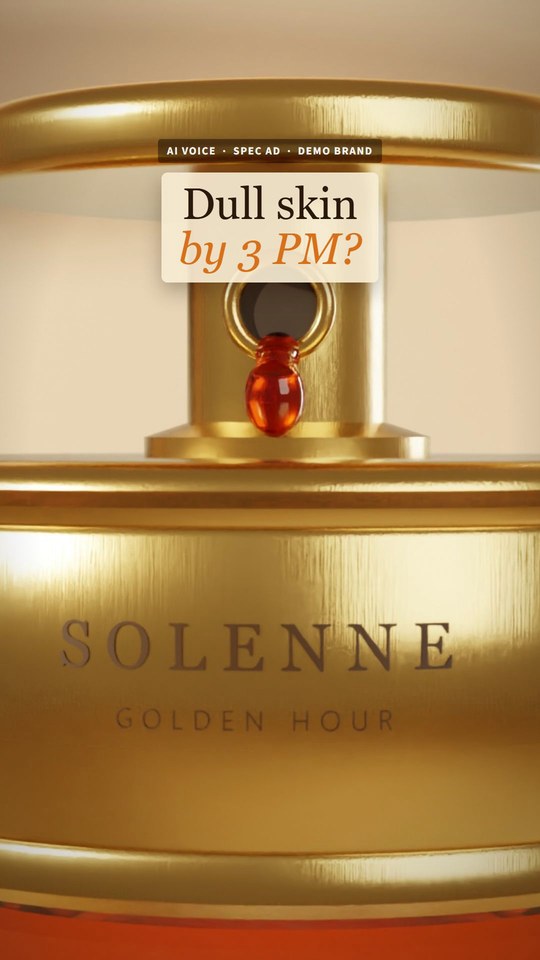
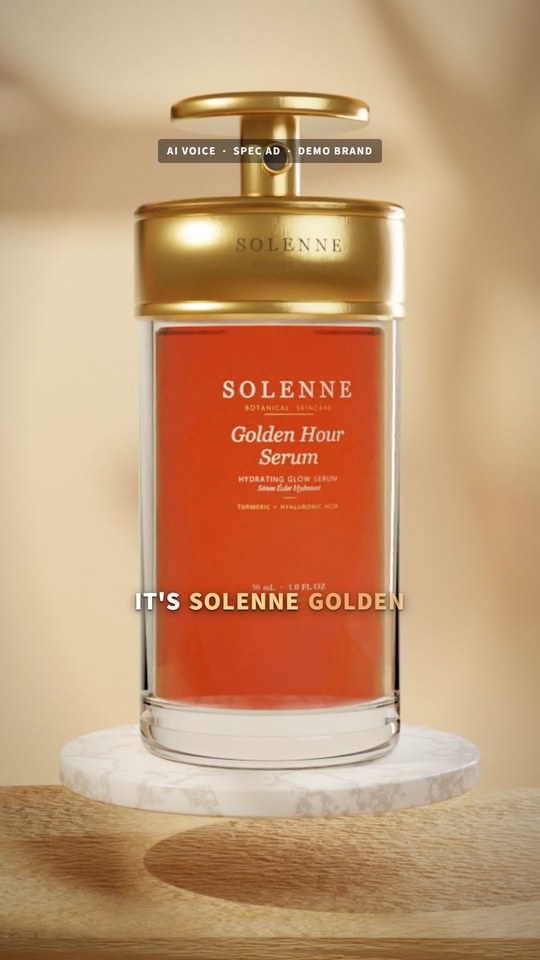
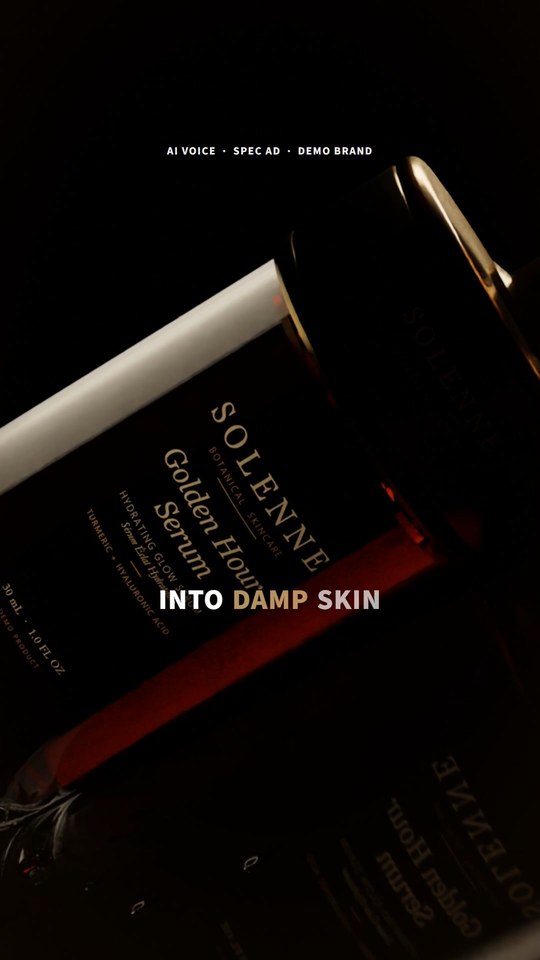
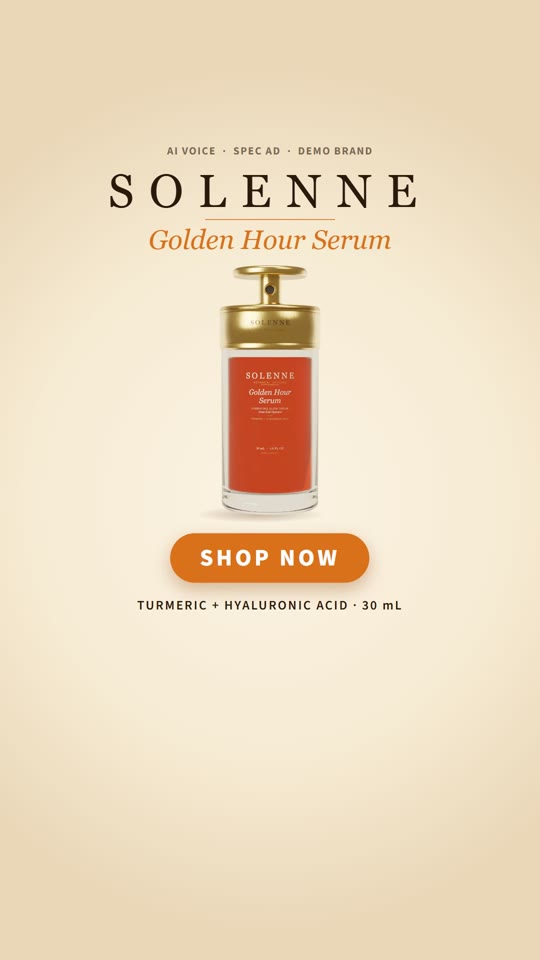
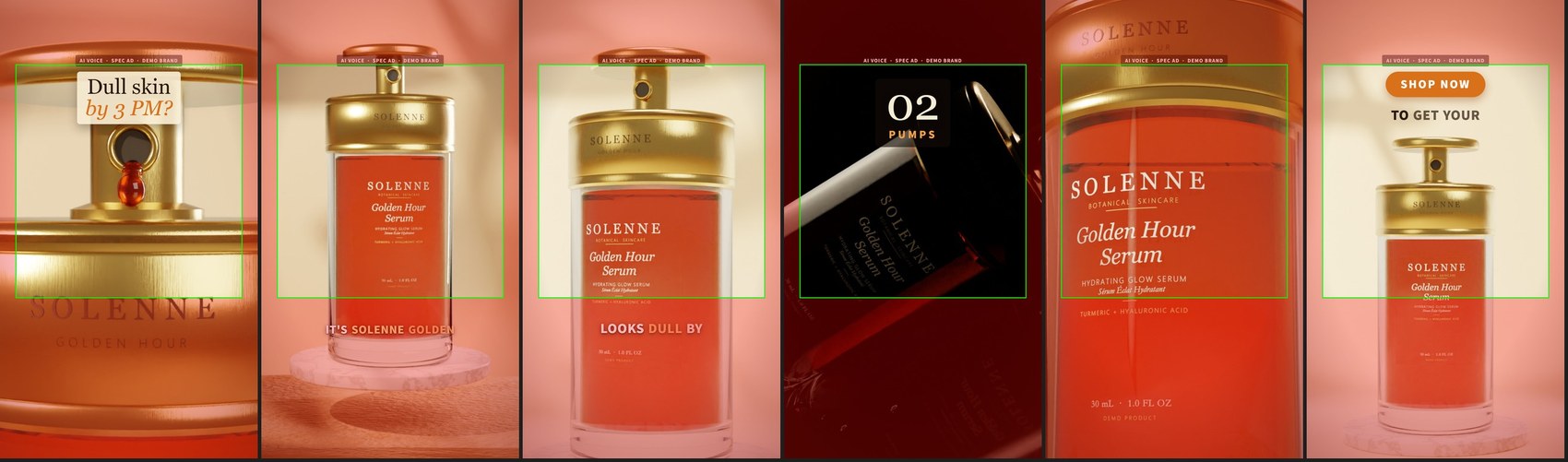
Ad cut, 17.8 s. Same 3D render, recut for paid social: hook, AI voice-over, captions, Shop Now card. Every caption and button sits inside Meta's ad safe zone.
The brief
A small skincare brand has a bottle, a label and a launch coming. A premium price needs premium images, and a glass bottle full of amber liquid is hard to shoot: the glass reflects everything around it. The brand needs three things that look like one campaign: a short film that sells the product as an object, an ad that can run on Instagram and Facebook without the app's buttons covering the message, and clean stills for the store page.
We set this brief ourselves and treated it like a paid job: written brand rules, allowed claims only, every step checked before the next.
How it was made
Intake
What we ask a brand for:
- Photos of the bottle from the front, side, top and back on a plain background.
- Height and diameter, or the fill size.
- The flat label artwork their printer uses (PDF, AI or PNG).
- The claims they are allowed to make, and the words they never use.
If the brand already has a 3D or CAD file of the bottle from their packaging maker, we start from that and skip the modelling.
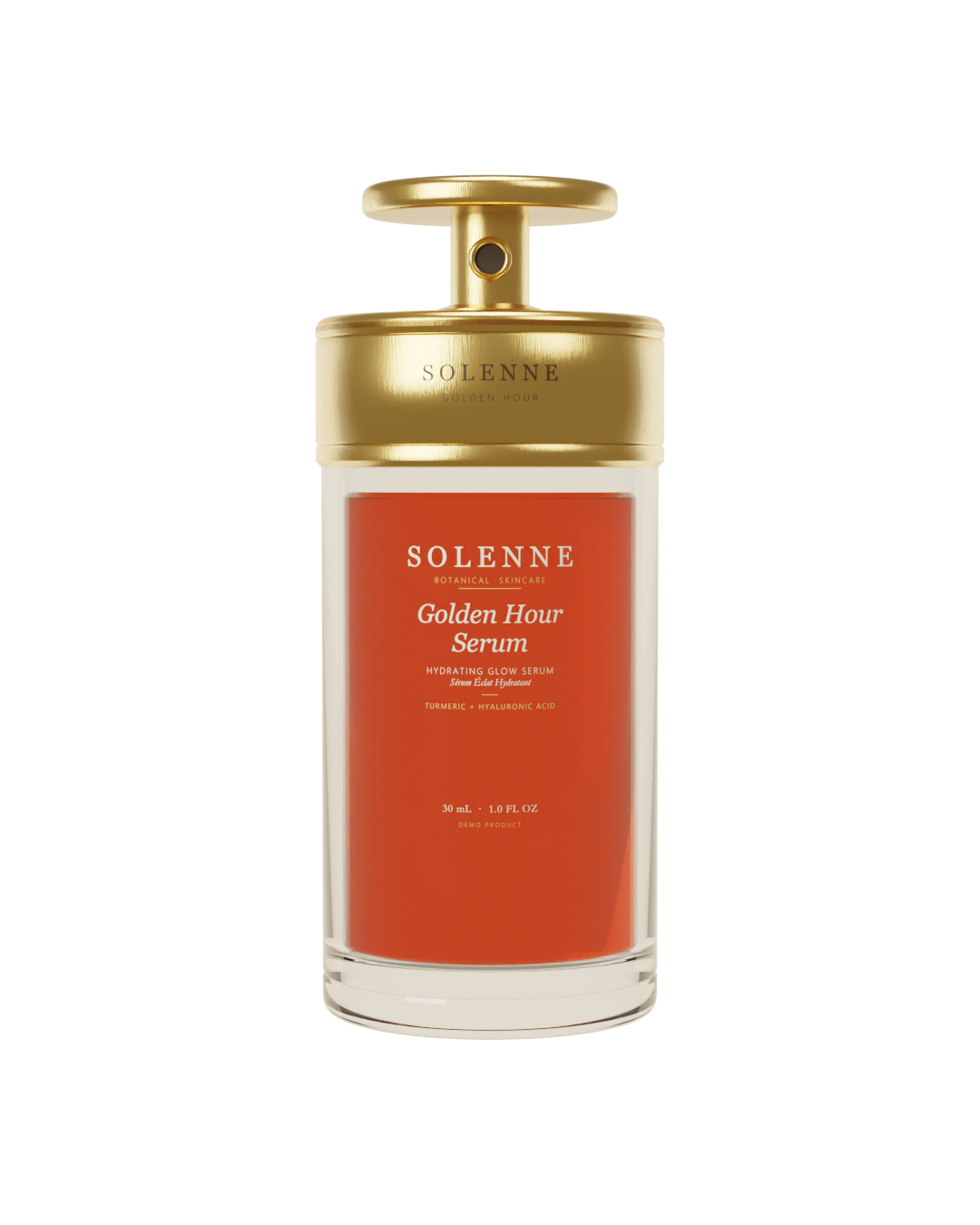
Build the bottle in 3D
The bottle is built from its side profile, spun into a full shape, then given thick glass, a brushed-gold collar and pump, and amber serum inside. The label artwork goes on as print on the glass, so the brand name stays sharp in every close-up. In our own AI video test of this bottle, the label's small print came out soft; the 3D build keeps it exact.
Two lessons from this bottle: a full cylinder of liquid acts like a lens and shows everything behind it, so props are hidden from the glass and a soft glow card sits behind it. Hard streaks across a label are light reflections; we found each one by switching the lights off one at a time.
Storyboard and film
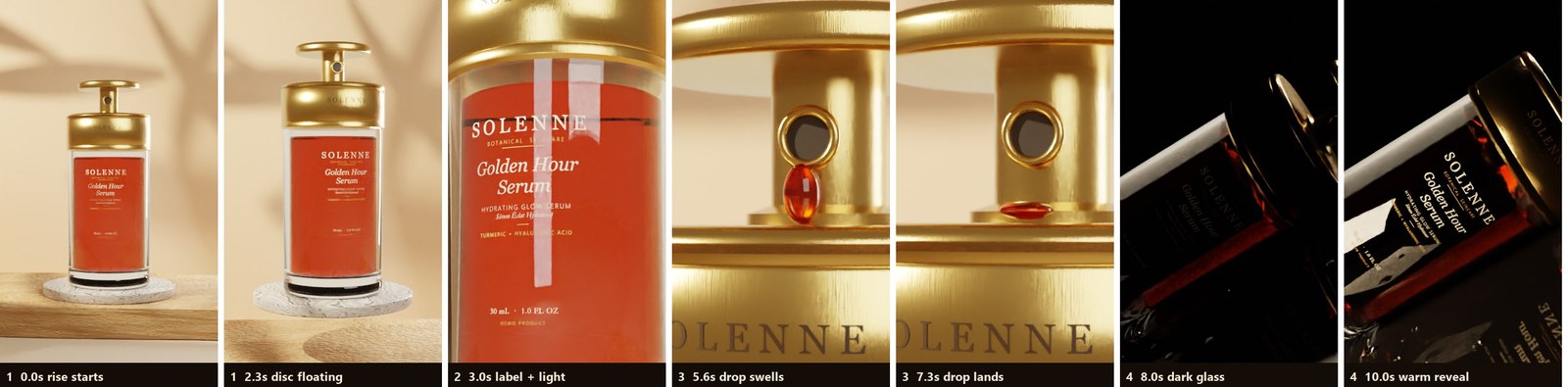
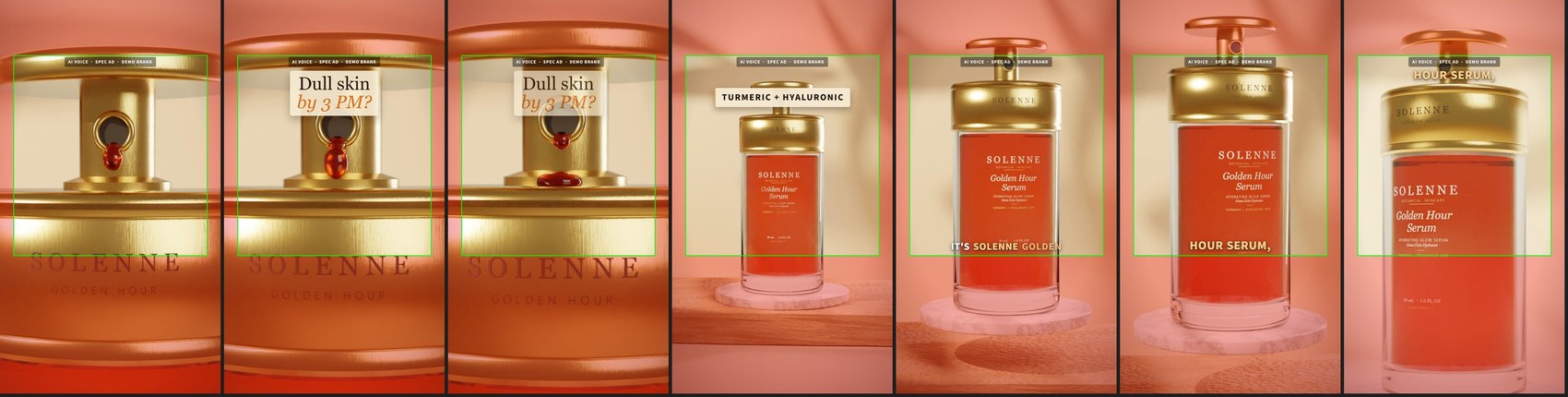
Before any long render, every shot is drawn as a storyboard frame and approved. The film follows one idea: a single amber drop. It forms at the pump, the bottle rises, the camera moves over the label, the glass shows wet light, and it ends on a clean product shot and a brand card.
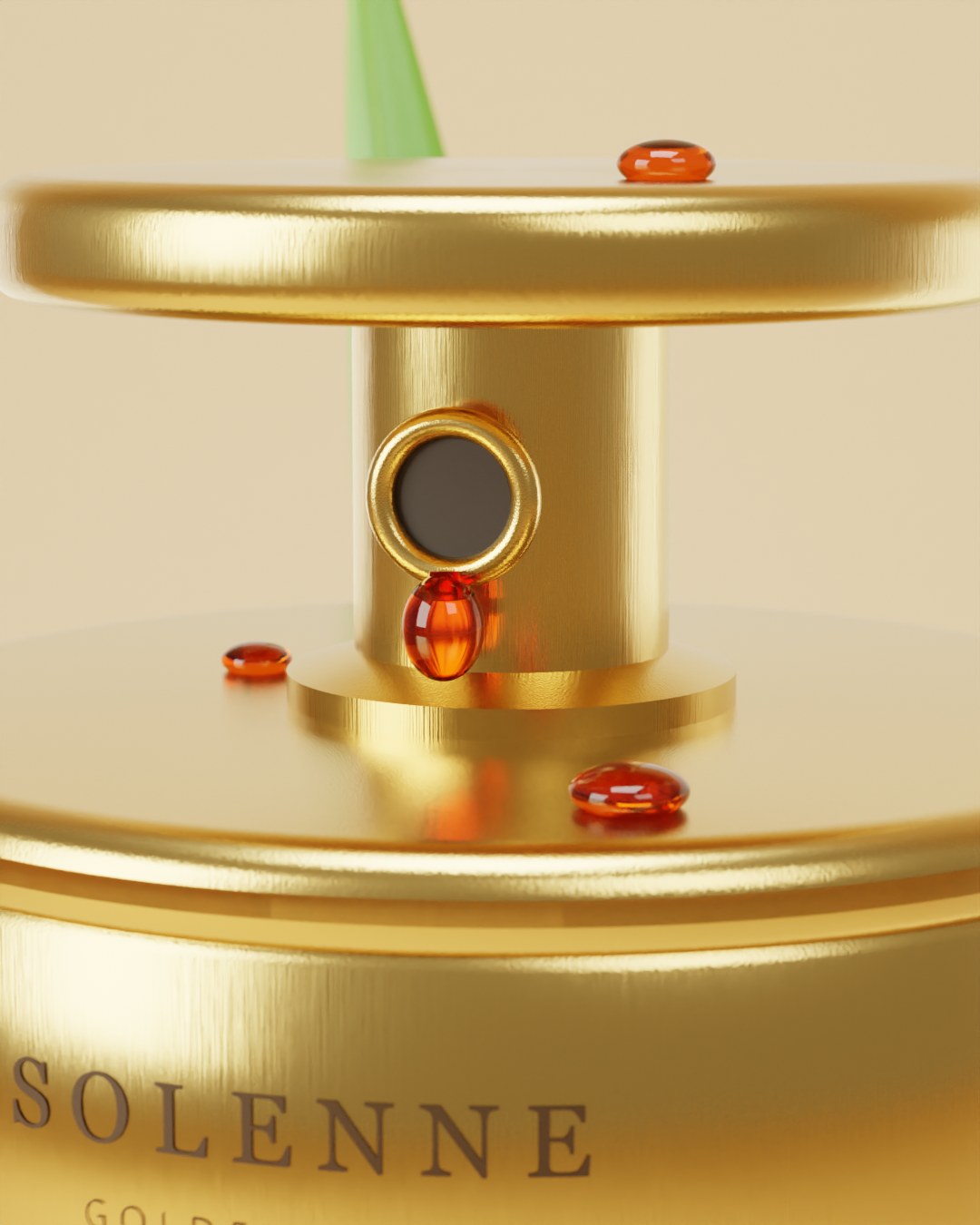
The drop is built as one connected liquid shape that swells, stretches and snaps off the pump. An earlier version used a simple sphere and read as fake, so it was rebuilt.
Recut it as an ad
- Script written as a product demo, not a review. No person says "my skin". A review from a person who does not exist breaks the FTC's rule on fake testimonials.
- 42 spoken words, cosmetic claims only: "hydrated feel", "healthy-looking glow". No "repairs", "treats" or before/after.
- The on-screen hook "Dull skin by 3 PM?" works with the sound off.
- Captions use the exact script words, timed word by word. They hide while a label chip shows the same words, so text never doubles.
- Voice is an AI voice, labelled on screen with "AI voice · Spec ad · Demo brand".
Fit Meta's ad safe zone
Meta asks advertisers to keep text and logos out of the top 14%, the bottom 35% and 6% on each side of a Reels ad, because the app's own buttons and captions sit there. Our first version followed the looser zone used for normal posts, and its captions and Shop Now button sat in the bottom 35%.
Version 3 moves every caption, chip, button and label into the zone. A script measures each piece of text on every one of the ad's 534 frames: none of them is outside.
Quality gate before anything is shown
Nothing goes to a client until it passes these checks. The numbers are measured on the final files.
| Check | Result | How | |
|---|---|---|---|
| Every shot looked at full size: start, middle, end, plus close crops of glass, edges and text | 11 defects found and fixed in the film before review (light bars over the label, a dark band in the glass base, a cut-off brand name) | Frame-by-frame sweep | Pass |
| Text inside Meta's ad safe zone | 0 of 534 ad frames outside | Script measures every text box per frame | Pass |
| Loudness | Ad −14.1 LUFS, film −14.7 LUFS | EBU R128 meter | Pass |
| Voice clear over music | Music about 23 dB under the voice | Calculated from measured voice and music levels | Pass |
| Unplanned black frames | 0 in the film. The ad has one planned dip between two shots. | Black-frame detection | Pass |
| Claims and script rules | Cosmetic claims only, no testimonial, CTA says what the viewer gets | Script audit against FTC 16 CFR 465 and the brand's claim list | Pass |
What the brand gets from one build
- Launch film, 18.5 s, 9:16
- Ad cut with voice, captions and Shop Now card, 17.8 s, 9:16
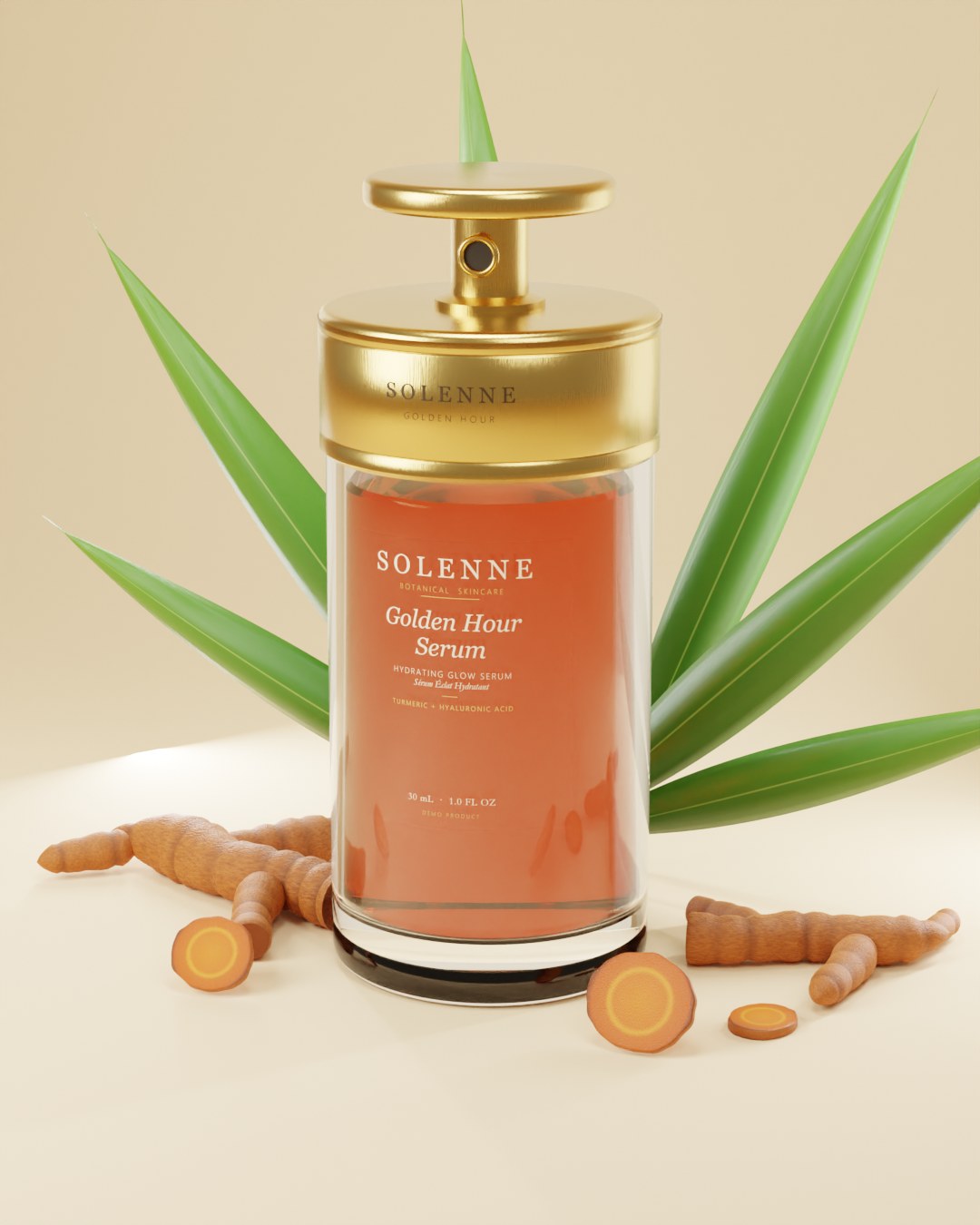
- Hero, three-quarter and macro stills, 4:5
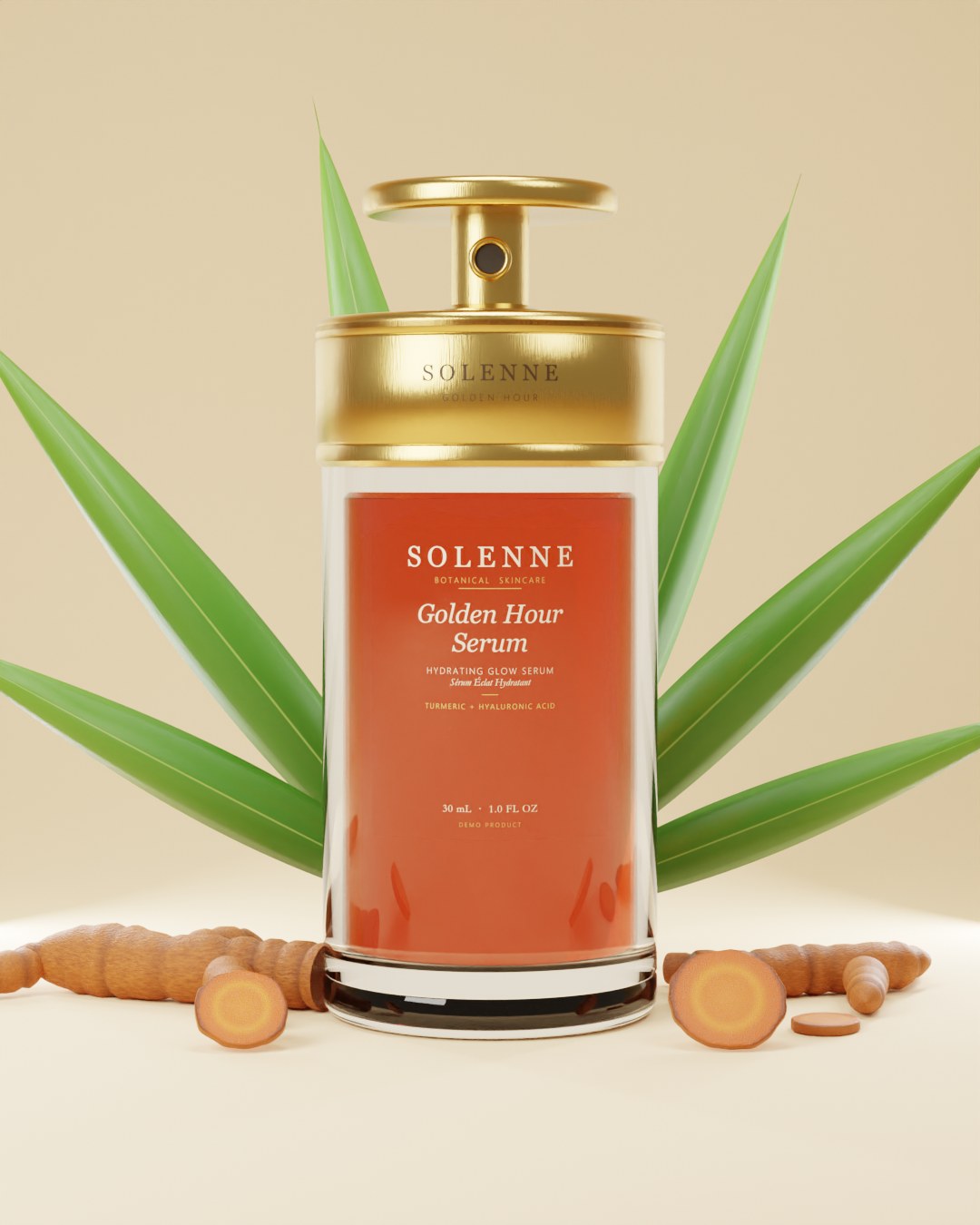
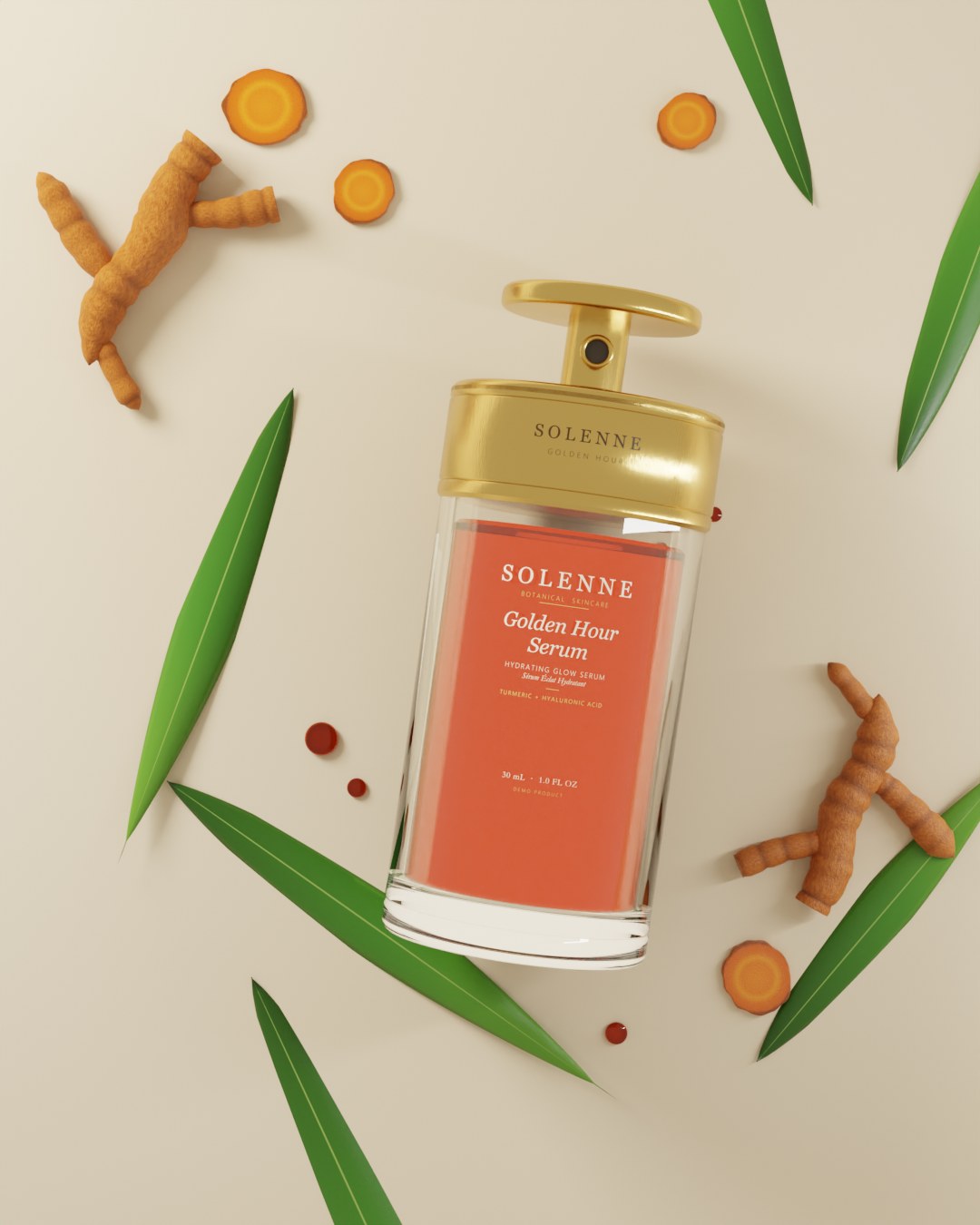
- Flat-lay still with botanicals, 4:5
- Transparent cut-out of the bottle for the store page and thumbnails
- The 3D bottle kept on file, so new angles and new ads start from the finished model
What we would test next with a real brand
This is sample work, so there are no ad results yet. With a live account, these are the first three tests we would run, one change at a time.
Opening line
Voice opens on the product ("This amber drop is…") against voice opening on the problem ("Dull skin by 3 PM?"). We read the share of viewers still watching at 3 seconds, and keep the version that holds more of them.
Length
The 17.8 s cut against a 10 s cut built from the same shots. We compare cost per click to the product page over the same budget and dates.
End card
The cream brand card against ending on the live product shot with Shop Now. We read click-through rate on the last two seconds' audience.
Honest limits
SOLENNE is not a real product and has never been sold or advertised, so nothing here proves sales. The film frames were rendered at 720×1280 and scaled to 1080×1920. Meta recommends 1440×2560 for delivery, and a paid job would be rendered at that size on a rented GPU. Some print on the bottle itself (the small "30 mL" line, the embossed collar in the opening macro) falls outside Meta's text zone. For a client we would set the camera framing for the zone before rendering.
Your bottle next
Send photos of your bottle and your label artwork. We will make the first short piece on your real product free, so you can judge the work before paying anything.
styleframestudio.sameer@gmail.com